


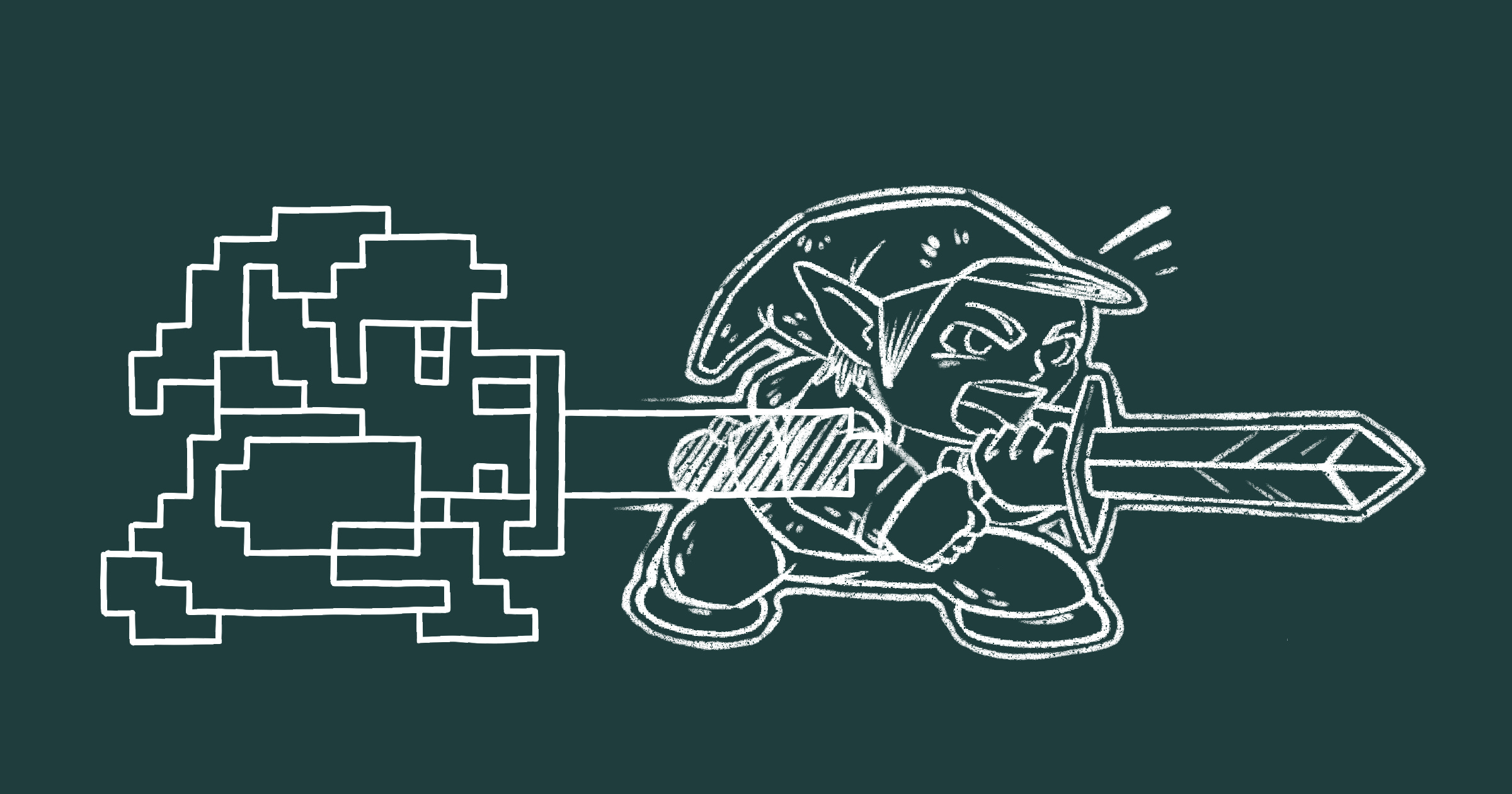
We dance round in a ring and suppose, / But the Secret sits in the middle and knows.
Robert Frost
Forty years in and The Legend of Zelda keeps its secrets. Nietzsche tells us the Buddha’s shadow was visible on a cave wall centuries after he died, and the Zelda franchise summons the same shiver in the skin: the immanent sense of something gigantic which is invisible to the senses but indisputably in existence, a black hole you cannot see, except by what it warps.
By custom, and by the rites and laws which govern the modern enshittification of IP, the marrow of Hyrule’s mystery should have been sucked dry long ago. Our hearts should have been broken by this series. We should be drowning in extractive prequels that overexplain everything, shameless hustling tie-ins, maybe even “Zelda: High School” or “Li’l Ganon” YA novels. Every unanswered narrative question ought to have been annealed into canon. Key to Zelda‘s strangeness is this: A multibillion dollar franchise has resisted all attempts at unriddling. The right old sacred fire has no business burning this long.
Your humble author pauses here to suggest this four-decade inscrutability is no accident. It is baked into the saga: at first by necessity, then by design. The Legend of Zelda series are usually described as “action-adventure” games, which is about as accurate as calling Lionel Messi a useful biped. The word for Zelda is numinous.
Numinous is a religious-studies term. We tend to imagine the holy as something pure and morally perfect. But intense religious experience, the numinous, is beyond this. The numinous is the experience of a reality that feels wholly other, a mystery which awes even as it puzzles. I don’t mean the incidental spiritual window dressing—the temples, goddesses, glowing triangles. There’s something deeper at work here.
Part of the secret is that creators Shigeru Miyamoto and Takashi Tezuka built the games around emptiness and the silence of sacred places. The first game, The Legend of Zelda (1986), opens in a ruined post-human wilderness. On the starting screen you have the choice to enter the cave and receive a sword. Or not. Nothing has been explained. The game simply is, as the world is.
Hyrule feels inhabited by powers and principalities rather than by societies. There are no towns. No dialogue beyond gnomic text utterances by weird old hermits who live underground, received only when you clamber downwards into dark apertures, like Orpheus seeking a boon in the depths.1 When Link moves from one square of the map to another, the entire screen shifts—literally, it pans in the direction you’re walking. And there’s a moment, just a fleeting moment, when the new landscape is there, totally empty, and then, a lagging second of processing power later, it is peopled by omens and monsters. The emotion this summoned in child-me doesn’t have a name.
The liminal is omnipresent in Zelda. The healing fairy pools and whistle and haunting dungeon theme hint at an ancient contract you are not privy to. Hidden entrances are everywhere. You seek Triforce fragments, the bits of a shattered divinity that you do not understand and yet are, somehow, reassembling. Curiouser still, no new levels are added, because the relics you find (the candle, the ladder, the raft) simply make additional layers of the already-existing world legible. Reality doesn’t change; you do. You are a pilgrim, not a conqueror.
The climax of the game takes place atop Death Mountain, a sacred peak where reality is thin, like Sinai or Olympus, and the last lair, Level-9, hides beneath Spectacle Rock, two bizarre stones which make the final dungeon seem like an elaborate tomb. The monster at the end of all this is Ganon, an invisible demon visible when struck. You’re fighting a hostile presence more than a body. And how appropriate. In Hyrule, the numinous is not confined to magical items or graveyards, but suffuses everything. The game is even named for an absence: not “Link’s Quest” but The Legend of Zelda.
Really, put yourself back in 1986. Adults know video games are designed. Children aren’t so sure. The game, with its famous golden cartridge, seemed like an artifact to me. One can’t forget, now, can one, how little is said. Who is the old man? Why should I take this? What is Dodongo, and why does it dislike smoke? There is a narrative of four sentences in the opening screen, and there was a short manual included, but that is pretty much it. The protagonist, explicitly named Link, is a no-person, by design: much is projected upon him. This is the smile hiding behind Majora’s Mask, by the way: Link is already a mask, our mask. How can you put a mask on a mask? He is not psychologically elaborated because the hollow center is part of the spell, a little green absence moving across a mostly-empty map.
And that map matters. Early video games had severe constraints: memory, graphics, and processing were puny. Zelda used its limitations like judo. It had few choices, but it made them correctly. Out of poverty of information came ambiguity; out of technical constraint came emptiness; out of inability to explain everything came a world that felt older than explanation. The makers were less interested in creating a coherent fantasy narrative than in evoking the feeling that the Hyrule was permeated by a hidden significance, and creating this emotion is a matter of precision, not power. The reality of numinousness arose from the necessity of design.
This is why the original Zelda, and all Zeldas since, feel less like a narrative and more a ritual reenactment, like the ancient Greek mysteries or the experience a young hunter-gatherer might have had being initiated into adulthood: You go out, wander, find a meaningful item, descend into a symbolic underworld, return changed, and then do it again.
Modern games often live in fear of silence. Nothing is ambiguous, not for long. The player is treated as a customer and tourist, shepherded through with codices. There is an assumption that more meaning is always better. But play is very easy to lose in all this effort. Wonder needs space. The visceral pleasure of games is tied to the sustained pressure of challenge, and what greater challenge is there than the unanswered? Can you imagine the feedback if Zelda came out today? “Where is the helpful arrow telling me where to go?”
Nintendo realized what they had.2 Miraculously, later Zelda games preserved the feeling. Link to the Past has more story, yet remains obscure where it counts. Link’s Awakening almost says the quiet part aloud: Am I dreaming? Are you? Breath of the Wild and Tears of the Kingdom expand the good old emptiness into gorgeous vastness: abandoned technologies and the melancholy of a world after catastrophe. If Elden Ring impresses us with the feeling that Something Has Happened, Zelda got there first.
That is why the numinosity of Zelda makes one nostalgic for something that never was. It reminds us of the structure of childhood, of intuiting rules before anyone states them, of the lurking suspicion that all observant children eventually have: I am not being told the whole truth; the adults are keeping secrets from me. It shares something with the world’s great religions, where we are forced to reckon with a reality we have no explanation for—something unimaginably greater and older and stranger than ourselves. The Sacred Realm, the Master Sword, the Sages, all of it looks meaningful, but never in a way that fully submits to a system.3
The joke at the heart of the Zelda series is that the Princess is the subject, but not the owner, of the story. We ourselves are the enactors of the legend. I seem to recall being told rumors about Zelda at my elementary school: Play this whistle, push this stone. What if the entire saga is understood as the same fable recounted by different tellers? The first Legend is the story as told by a child. The Adventure of Link is a teenager’s narrative. Link’s Awakening is a version recounted by a sailor who once heard the details of Link in passing but forgot Ganon or the Princess. Majora’s Mask is told by an adult obsessed with the mutability of identity. And on, and on.
Maybe that’s the point. Zelda’s deepest act of design was to leave enough unmade for the player to complete it. Games become real, like the Velveteen Rabbit, through love and interface with a human, and we have loved Hyrule too well and too long to impoverish it with questions. Maybe one day Nintendo will be foolish enough to explain it all. But I’m confident the Legend and its sense of a great perhaps will endure. You can never empty Zelda with words. There is, always and forever, an iceberg feeling, as of a great bulk eternally out of sight below the waterline, and a voice whispering: It’s dangerous to go alone, take this . . .
Jason is a writer from West Texas who now lives in Boston. He has been published by Salon, Paste Magazine, McSweeney’s, and the Comics Journal. Alan Moore once called him “mate.”
The later games are burdened with audible talk, a regrettable reality of the ludic economy. Inserting sound dialogue costs almost nothing, given the leaps in audiovisual presentation since the turn of the century. Mimesis is a pretty poor metric for imagination, as CGI has proven time and again. What’s remarkable here, though, is that this series preserves its numinous quality by selective refusal to explain itself. Remember Hitchcock correctly diagnosing sound’s effect on moving pictures: “The silent pictures were the purest form of cinema; the only thing they lacked was the sound of people talking and the noises. But this slight imperfection did not warrant the major changes that sound brought in. In many of the films now being made, there is very little cinema. They are mostly what I call ‘photographs of people talking.’”
That said, it wasn't just the limits that dictated numinosity, though the limits were primary. Miyamoto's rural childhood in Sonobe is relevant here: "I went hiking and found a lake. It was quite a surprise for me to stumble upon it. When I traveled around the country without a map, trying to find my way, stumbling on amazing things as I went, I realized how it felt to go on an adventure like this." The visionary and the necessary merged in a hybrid aesthetic experience which the makers had the good sense to retain.
Nintendo’s Zelda 2011 timeline should not be taken seriously by anyone. Let's call it what it is: an after-the-fact cobbling together of wildly disparate game threads that were never intended to be lumped together in anything like a cohesive narrative. It took them twenty-five years to reveal a dedicated master plan?

I love nothing more than an essay that makes me fascinated by something I've never paid any attention to.