


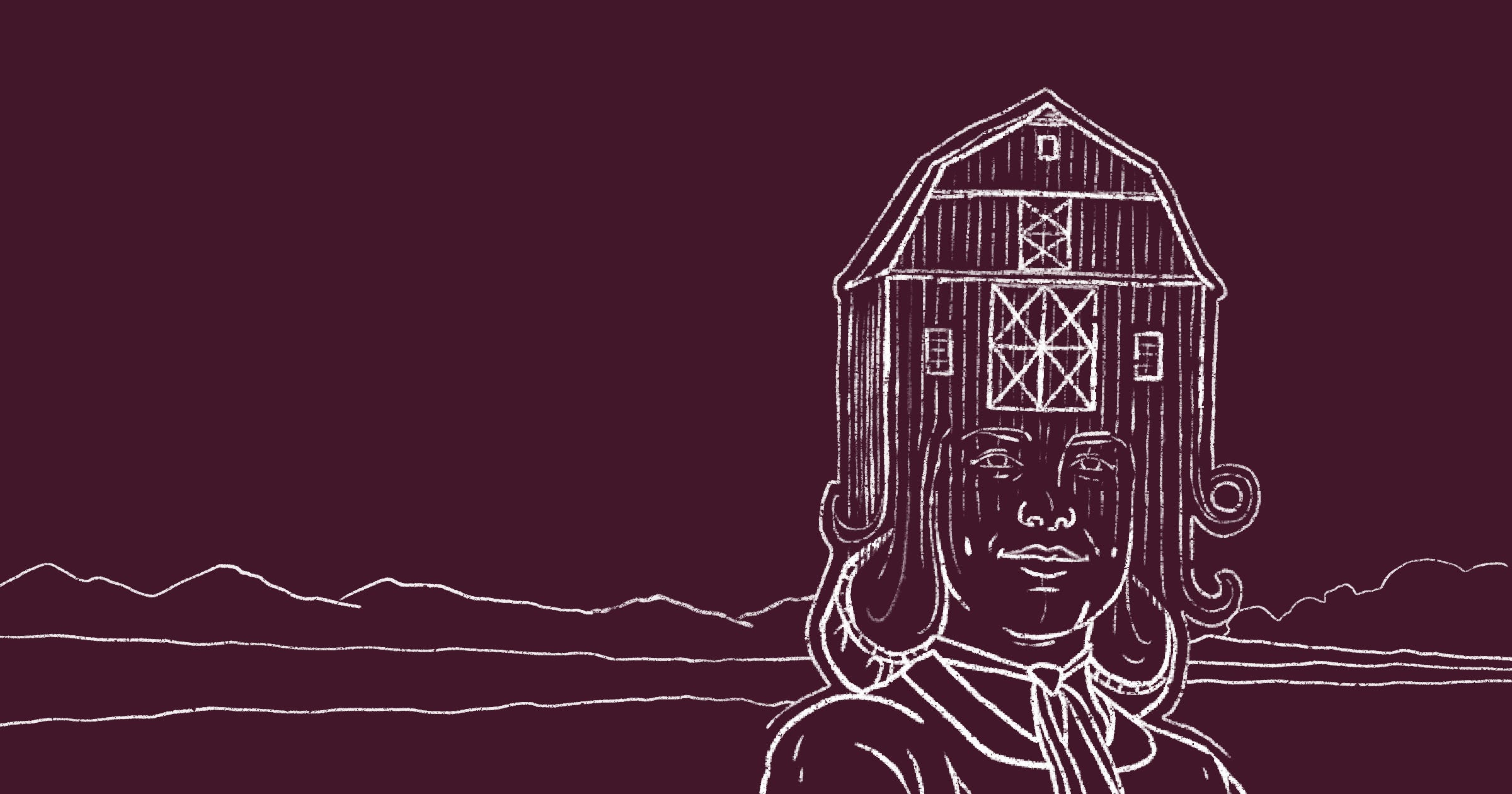
Trad wife discourse is everywhere. (If you haven’t been caught up in it, could you make some space for me under the rock where you’ve been hiding? But just in case—a “trad wife,” short for “traditional wife,” is a woman who follows traditional gender roles, often through homemaking, having many children, and submitting to her husband. And, increasingly, posting about it on social media.) The publishing world has capitalized on the trope with books about the polished influencer hiding a secret—she’s living a double life, or she’s murdered someone, or she’s made a deal with the devil, or she’s a zombie who plans to livestream herself eating her husband’s brain.1
None, however, have had quite the reach of Caro Claire Burke’s debut novel Yesteryear. The book sold for six figures and was optioned for film by Anne Hathaway’s production company before its April 2026 release. The premise is compelling: Homesteader and Instagrammer Natalie Heller Mills, mother of soon-to-be six children and expert sourdough maker, wakes up in 18552 and must live the lifestyle she’s been romanticizing online. But most compelling for me were the parallels to Mormon influencers. In a media moment where Mormon women are being sensationalized, vilified, or flattened but rarely portrayed faithfully, I was curious to see how the author would handle a character from my faith background.
Natalie announces her persona almost immediately: “My name is Natalie Heller Mills, and I was perfect at being alive.”3 But of course, Natalie’s life is not the curated tableau she displays online. Yesteryear Ranch is staffed with dozens of behind-the-scenes helpers. Natalie’s marriage is loveless. She doesn’t recognize her youngest child because she spends so little time with her. And her presidential candidate father-in-law, who funded the ranch, is pressuring Natalie to birth even more children, to guide her hapless husband, and to maintain the illusion that the Heller Mills family is the Platonic ideal of the American Christian family.
Natalie comes to see herself as split in two—her online persona and the real woman she represses. As an unreliable narrator, her character seems to be in costume, too. She looks and talks like a religious person, and she cites religion as a motive, but she doesn’t seem to have an active spiritual life in spite of her constant communication with the Lord, who feels like a stiff, angry idol rather than a loving being guiding her towards goodness. The tenets of Natalie’s personal doctrine are following traditional gender roles and faking perfection for an audience—her insatiable followers, but also a God whose main role is observing her like his personal reality show.
Natalie has one experience that suggests actual spiritual communion—she is baptized shortly before leaving for Harvard, and for a few moments, she is engulfed in fear: “Then I dropped beneath the water, and the fear fell away, and the warmth—the love—came tunneling through.”4 But Natalie never refers to the love of God again; for a short period of time, she thinks God is pleased with her for acting like a good frontier wife despite her disorientation, a sense of correctness that fills her with sexual pleasure, but she never again speaks of love. When Natalie’s empire starts falling apart before she wakes up in 1855, her mother, who has recently left the strict church of Natalie’s childhood for a more progressive denomination, shouts, “You think kindness is some silly frivolous side virtue, when it is in fact the whole damn thing!” Rather than listening, Natalie fixates on her mother’s wrongdoing: “I’d never heard her say a curse word in her life.”5
To Natalie, the “whole damn thing” is performance. As readers, we never learn much about her home church other than brief descriptions of how its members act (wearing prairie dresses and braids, rejecting divorce, etc.), so we don’t know its central doctrines. Natalie’s obsession with performance is crystallized by a conversation with her mother. Postpartum and struggling to reconcile her illusions about motherhood with reality, Natalie asks her mom how she managed, and her mother says, “I would imagine I was being watched. . . It felt a little less lonely when I pretended I had a little audience sitting on the couch with me.” When Natalie questions her mother about whether this pretense is okay in the Lord’s eyes, her mother says, “Who is our Lord and Savior, if not the original audience member for our lives?”6 Natalie draws her own conclusions: “Motherhood is its own kind of curation. Which is to say: every woman I know lied to me about what it would be like, before I became one myself.”7 Rather than moving toward authenticity to prevent other women feeling duped like Natalie does, she chooses to lie, too, by presenting her life as idyllic and enviable.
Some of Natalie’s obsession with performance may stem from rejection: Her father leaves their family; at Harvard she’s a religious oddity. When taking an online influencer course, the group tells Natalie she comes across as unlikable and unrelatable. “It looks like you’re pretending,” they tell her and recommend she practice smiling in the mirror. More than once, I wondered if she was neurodivergent. Masking, or disguising traits to fit in socially, can feel like a performance. Natalie constantly tells herself how to be more likable: “Too sharp. Too high. Lower your voice.”8 Natalie’s drive to become what she believes she should be makes her difficult to pin down; the real woman is elusive, obscured by increasing extremes as she strives to keep her kingdom from toppling. Polishing her castle walls becomes the purpose of Natalie’s life, but it’s a Disneyland facade.
But fair or not, I wanted Natalie to perform religious womanhood better. Anyone who has spent time in the trad wife space can see that the women she’s loosely inspired by are Mormon, but I didn’t recognize myself in Natalie. I don’t really recognize myself in women like Ballerina Farm’s Hannah Neeleman, either: She’s a mother of nine, births her children at home, and competed in the Mrs. World pageant at twelve days postpartum. But the author’s avowal that she’d interviewed Mormon women had me hoping that the story would feel like it could have been mine, even if it wasn’t told from a sympathetic point of view. I wanted accuracy. I wanted to see myself in the story, even if it was in an unflattering light. As Mormon culture writer Rebbie Brassfield put it in her review, “I want it either to be about me or not be about me.”9
Of course, authors are not beholden to the expectations of their readers. I wanted a complex portrait of a Mormon woman (and believed, based on pre-publication chatter, that the character would be, if not complex, Mormon), but instead I received a character standing in for a whole spectrum of vaguely religious women who purport to be apolitical, but whose lives are twisted to support political narratives. Natalie’s ideologies are likewise fuzzy; her priority is maintaining the illusion of perfection. Her page is used by YouTubers and her politician father-in-law as propaganda for what good wives should look like, but Natalie never explicitly stands for anything. Political and religious beliefs are just additional layers of makeup.
According to the author, this was intentional. “Her relationship to religion kind of moves in and out,” Caro Claire Burke said in an interview with The New York Times. “Her relationship is very transactional.”10 Mormon religion writer Jana Riess agrees with Burke’s choice to make Natalie’s religion vague: “The novel accurately depicts how shallow American religion has actually become. . . . Political identities have become oddly fixed, while religious ones are only sparsely grounded in actual religion.”11
Fair enough. Burke’s intent was never to tell a Mormon woman’s story—rather, it was to look at the performance of a fantasy of womanhood and how it can be weaponized to promote ideologies. But as someone who makes up part of the composite of religious womanhood Burke nips and tucks into her polarizing protagonist, the book feels like a dissonant chord that just won’t resolve. Maybe that’s because, as Burke said in her NYT interview about her decision to only interview women with “one foot out” of religion, “If you’re still in it, I don’t think you have the distance to be able to help someone like me with the project [Yesteryear].”12
Maybe I am too close to the source material to see it with perspective. Yesteryear was written to challenge readers, and if the online discourse is any indication, it succeeded. But I wish the author had gotten closer to the source material she mined and then frankensteined together. Yesteryear could have been more than a shocking exposé of a disturbed woman posing for the camera. Written with more specificity, I believe Natalie could have been more impactful and believable—perhaps even a character I could root for. Maybe this wish proves the author’s point that demanding feminine palatability creates the conditions for a character like Natalie to emerge. But I don’t want an easy character; I just want one that feels real: flawed but nuanced, unflinching in living out both the bright and dark facets of religious womanhood. She wasn’t in the pages of Yesteryear, but I’m hoping one day I’ll open a book and meet her.
Lorren Lemmons is a mother of three living in Idaho. She loves spending too much money on special-edition vinyl records, reading excessively to avoid reality, and dropping Taylor Swift Easter eggs into her writing.
Some recent publications include The Tradwife’s Secret by Liane Child (2025), Everyone Is Lying To You by Jo Piazza (2025), Trad Wife by Saratoga Schaefer (2026), Tradwife by Michelle Brandon (2026), and The Secret Lives of Zombie Wives by Barbara Truelove (forthcoming in 2027).
Advance copies of the book and early marketing copy placed Natalie in 1805, but the date was changed, presumably because Idaho, where her ranch is located, was not colonized by white homesteaders yet. (1855 is also a bit early, since there were few white settlements until the 1860s.)
Caro Claire Burke, Yesteryear (Knopf, 2026), 4.
Yesteryear, 35.
Yesteryear, 335.
Yesteryear, 147.
Yesteryear, 12.
Yesteryear, 284.
Rebbie Brassfield, “Commentary: Why isn’t the tradwife bestseller ‘Yesteryear’ about Mormonism?” The Salt Lake Tribune, (Salt Lake City, UT), June 13, 2026.
Caro Claire Burke, “Why You Should Read ‘Yesteryear’ Now,” interview by Lauren Jackson, The New York Times, May 10, 2026.
Jana Riess, “‘Yesteryear,’ a tradwife satire, understands Christianity better than most Americans,” Religion News Service, June 29, 2026.
Caro Claire Burke, “Why You Should Read ‘Yesteryear’ Now,” interview by Lauren Jackson, The New York Times, May 10, 2026.
Lorren! I could kiss your face for articulating so intelligently and resonantly what I felt about this story. I wrote the novel I think you’re looking for—Yesteryear in reverse, and minus the psychosis, because religious conditioning can feel like such without the extremity of a full-blown delusion. My character leaves tradwifery and breaks from her conditioning to build a life she chooses for the first time. It also offers what I wish I got more of from SLOMW: a zoom-in on one character and the nuances of faith transition. Thank you for this review!
Wow! What a thorough review. This was excellently written! I haven’t read Yesteryear yet, though I’ve read much of the online discourse around it. You’ve convinced me to pick it up and dissect it myself, Lorren. Thanks for the prompting :)