

The Phone Calls of Napoleon Dynamite & "The Phone Call"


Circa 1989, the Clovis Third Ward youth took a trip to Los Angeles to do baptisms for the dead. There were too many of us kids to all serve in the baptistry at once, so they split us in half. While half one was in the LA Temple doing baptisms, the rest of us were shunted off to the visitors’ center. They put us in a theater and asked what we wanted to watch. They said they had everything. The right answer, of course, would have been something spiritually-minded like “The First Vision” (1976) or How Rare a Possession (1987), but I knew what I wanted to see and I spoke up first and everyone agreed. The good people of the visitors’ center knew conviction when they saw it, so they acquiesced and put on “The Phone Call” (1977).
If you were not young and impressionable the same time I was, perhaps you don’t remember as well or as fondly this classic out of BYU’s studios. You poor soul.
I recommend just watching it now, online, rather than waiting for the 4K restoration,
but if you can’t spare the twenty minutes (you can spare the twenty minutes) here’s a brief summary: Scott wants to call Pam on the phone and ask her out. He is terrified to do so. He is horribly awkward. His coworker, Becky, helps him out. Simultaneously, he helps her out.
Easily the most familiar face in “The Phone Call” is Mark McClure, who had appeared in Freaky Friday in 1976 and would appear in Superman in 1978. Between those iconic roles came his iconic role as Scott McCorvick. Yes, seen by only a sliver of the American population compared to Freaky Friday or (especially) Superman, but still, beloved by those of us who revere this stone cold classic.
Now look—Waypoints has only given me 800–1500 words to set “The Phone Call” alongside Napoleon Dynamite (2004), so let us take a few things as axiomatic:
One: The creators of Napoleon Dynamite were, intentionally or subconsciously, influenced by “The Phone Call.” Half the “Phone Call” comments on YouTube and Letterboxd make this argument and all of us twenty-something Mormons watching in 2004 accepted it as obvious. I was born in 1976. Jared Hess (Napoleon Dynamite’s writer/director) three years later; Jerusha Hess (writer) one year after him. Heck, even its actors are part of the Phone Call Generation: Jon Heder’s only one year off me and Aaron Ruell zero (and living in the same town as me at the time of my temple anecdote—QED). We, born-and-bred Saints all, were there together. We know Scott. We think Becky should drop Joe. We’re curious what weedkiller Pam uses. Long before Napoleon Dynamite, we had “The Phone Call.”
Two: Scott and Napoleon even style their hair with matching asymmetry. Ergo, for all their differences, there must be further connections to be made.
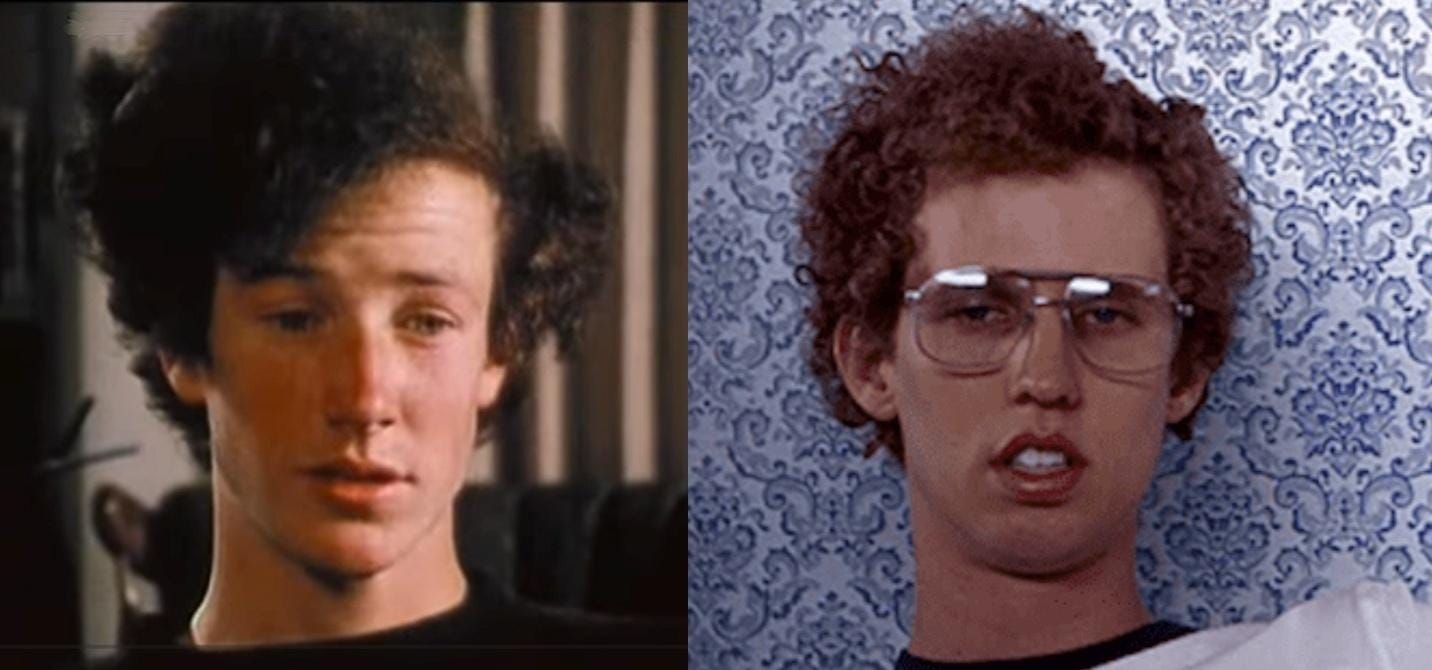
Three: Both “The Phone Call” and Napoleon Dynamite have no definite LDS tells. Those with conspiratorial tendencies will tell you otherwise, but aside from geography and maybe the cleanliness of language, there really aren’t.
And four: “The Phone Call’s” writer Jack Weyland and director Douglas G. Johnson love their characters just as Jared and Jerusha Hess love theirs. Someday I’ll write my book about this, but the Hesses’ love for their characters is the primary trait of their auteurial voice.
I’m not here to make any claims that the Hesses pored over “The Phone Call” while writing Napoleon Dynamite, and I think the differences between the films are as important as their similarities. But they operate in matching moral universes, and we will uncover meaningful resonance by noting similarities. Let’s begin today, by looking at both movies’ phone calls.
Each movie features five phone-call scenes. The primary difference between them is we never see the other side of Scott’s conversations but, with one brief exception (Uncle Rico getting a call and saying “Hello”), we see both speakers in Napoleon Dynamite. Let’s do a quick breakdown:
The phone calls of “The Phone Call”:
Scene one: We see Scott poring through the phone book. He makes a call. He speaks with Pam, confidently asking her out. In response he hears, “Your money is safe at State Savings. The time, 5:41. The temperature, 82 degrees.” He hangs up and tries again. We hear, for the only time in the film, Pam’s voice as she answers the phone. Scott freezes. He hangs up.
Scene two: To prepare for Pam, Scott takes Becky up on her offer and calls her instead. Scott is awkward. He roleplays Becky’s crummy boyfriend. It’s probably a jackass move, but Becky’s nice and knows Scott is nice and manages to hear what he’s saying. Though his inadvertent flirting leads to her hanging up, this is the beginning of better things for Becky.
Scene three: Becky accompanies Scott to a phone booth to offer moral support. He introduces himself to Pam as her paperboy. After hanging up, having accomplished nothing, he tells Becky, “Maybe I’ll call her a couple times to break the ice.”
Scene four: Together again at the phone booth, Becky takes Scott’s dime and dials the phone. Having reached Pamela Robinson of 1054 Riverside Drive, Scott McCorvick of 619 Riverside Drive talks dandelions.
Scene five: Scott, accompanied by Becky but having dimed and dialed himself, stumbles through conversation and into success by asking Pam down to the drive-in, promising her a banana split.
Now the phone calls of Napoleon Dynamite:
Scene one: From home, Napoleon calls his brother Kip because he doesn’t feel good. His lips hurt real bad. Kip does nothing to help.
Scene two: Someone calls Uncle Rico as he’s out in a field, filming himself throwing a football. “Hello?”
Scene three: Trisha, under duress (and engaging in Scott levels of awkwardness—albeit from a different motivation), calls Napoleon and agrees to go to the dance with him. After Napoleon hangs up, Pedro asks him who was on the phone. “My woman I’m taking to the dance.”
Scene four: Uncle Rico has been inviting local teenaged girls to call him “when they’re ready,” if they “can use something.” Instead, Deb calls Napoleon, whom she attacks and dismisses as a shallow friend based on the information given her by Uncle Rico.
Scene five: Napoleon calls Pedro to tell him Deb pretty much hates him by now. But he segues into proposing that Pedro finish his campaign by telling the student body that their “wildest dreams will come true if they vote for you.”
The only moment between those final two phone-calls scenes consists of Napoleon lying to Uncle Rico, claiming that Grandma called and wants him to leave and, if he won’t leave, he’ll call the cops. Neither of those phone-call scenes actually happens. Grandma had not called. Napoleon calls Pedro, not the cops.
After calling Pedro, Napoleon goes back to the window and looks at Uncle Rico. He sees a broken man, failing once more to capture past (and only imagined) glory.
He does not call the cops. He merely watches. And by watching, Napoleon comes to understand.
Scott’s phone-call–by–phone-call progress over his film is obvious. With Becky’s help, he gains the courage to speak to his crush. He goes from having no idea what a girl wants in a guy to thinking he might be just that. He begins to see worth in himself, just as he has always been able to see it in Pam and Becky.
Using only the phone call scenes to track Napoleon’s growth is more difficult. But when the film began, Napoleon was without friends his own age—talking to elementary-school kids on the bus and calling his brother for chapstick. By the end, Napoleon not only has friends, but he has complex relationships. One friend is mad at him. Can he save that relationship? Another is uncertain how to proceed. Whatever the quality of his advice, Napoleon is there for him.
Even those he’s not on the phone with he sees with fuller empathy. He may be mad at Uncle Rico, but also he recognizes the man’s tragedy. He’s no longer on the phone with Kip, but he can be satisfied and happy for his brother as Kip leaves Preston with his soulmate.
Napoleon Dynamite’s phone calls take us from Napoleon alone through Napoleon reaching out to the wrong person to Napoleon doing the work of being a friend.
Our two protags with their lopsided afros, subtle physical comedy, and awkward dialogue are not the same person and not on the same quest, but, together, they reveal subterranean metaconnections between Mormon films and how simple tools like a phone call can be used to craft characters. Young characters. Youth. Kids, really. Kids who discover that, like their hair, we all have more in common than we may have realized during the opening credits. This is what drove us eighties and nineties kids to want to watch “The Phone Call” whenever possible: It wasn’t just funny; it was a model of how to love yourself and how to see others. Instruction every thirteen-year-old craves.
Mormon wrote (I’m paraphrasing) that, since he was filled with charity, which is everlasting love, all children were alive to him. He saw them. This is what the filmmakers of “The Phone Call” and Napoleon Dynamite have in common. They love the children in their movies—these awkward young people trying to find themselves as they stumble adultward. They see them. They teach us, too, to love them.
And, more or less, this is what their heroes learn as well.
Charity in celluloid.
Theric Jepson recently spent girls camp quarantined in a far-away, internetless bathroom, where he read Moby Dick and The Message and a 1924 humor collection, and listened to music he’d too-long neglected, including near-perfect albums by K’s Choice (Cocoon Crash), Kevin Montgomery (Fear Nothing), and Amy LaVere (Stranger Me).
 | A guest post by
|