



The set of the 20th anniversary revival of Carol Lynn Pearson’s Facing East at Plan-B Theater is simple and confronting: an open grave in too-green grass with an immaculate red and white rose arrangement lying beside it. The backdrop is a photo from the Salt Lake Cemetery that has been edited to look like an impressionist painting with untidy but cohesive strokes.
Above the grave near the theater’s rafters, there are leaves fluttering in stasis. The leaves are cut out from pages of the LDS hymn book, and for the duration of the show, they will stay where they are, trapped, unable to heed the call of their nature and fall to the ground.
The other mourners are gone, and it’s just the parents of the deceased left.
Facing East follows faithful Latter-day Saint couple Ruth and Alex McCormick as they grieve at the graveside of their youngest son, Andrew (Andy), who took his own life on the grounds of the Salt Lake Temple. Ruth and Alex are joined by Andy’s non-Mormon boyfriend Marcus in the latter half of the play, and the three of them are left to grapple with this horrible thing that has happened.
On the stage, there is room in the grass around the grave for Alex, Ruth, and Marcus to move, to come together, to depart from one another for private moments of grief, but only just. The grave is the focal point, and it has its own terrible gravity.
***
It was the fall of 2012, and I was gay and (largely) closeted at BYU.
Not long after I came out to Terysa, a friend from elementary school who was raised in Utah just like me and who unlike me was not and had never been Mormon, she showed up at my student apartment with a carefully wrapped copy of No More Goodbyes by Carol Lynn Pearson.
“I went into the bookstore and asked them if they had anything for gay Mormons and they suggested this,” she explained. “I went to a lecture she gave at my school a while ago. She said she wrote that Primary song, ‘I’ll Walk With You,’ about her gay ex-husband.”
I’d read other books for gay Mormons, of course. It felt like I’d read all of them. And every single one left me more depressed, more hopeless than before.
No More Goodbyes wasn’t like that. For the first time in my life, I felt the Spirit while reading a book about being gay and Mormon. I felt seen. I felt the warm flicker of hope in my chest. Maybe I could do this.
In addition to hope, I felt hunger. Not the hunger of someone desperate and starving in the wilderness, but the hunger of someone who has tasted something good and wanted more.1 Deserved more.
That hunger drove me to seek out Pearson’s other works. I wasn’t brave enough to check any of them out from the Harold B. Lee Library, so one January afternoon, I stood in the stacks between classes and picked out the script for her play Facing East because it looked like something I could finish quickly.
I read the whole thing while standing on the library’s worn carpet, the weak, watery winter light coming in from the windows surrounding me on both sides.
“How does she know?” I asked myself, wiping away tears with the sleeve of my hoodie. “How could she possibly know exactly what I’ve been thinking and feeling?”
A play about a gay LDS man who took his own life might not seem like a healthy reading choice for a gay LDS woman who was considering ending her own life. How could a play about suicide do anything but drive an already suicidal person to take that final step?
But it didn’t.
It was, as Andy tells Marcus when they are reunited one fateful afternoon, a queer answer to prayer.
Standing in the HBLL that day, I was of course moved by how devastated Alex and Ruth are by the loss of their youngest son, imagining how my own parents would react to my suicide. But more than that, I was moved by how misunderstood Andy was in both life and death. I refused to kill myself if it meant that I would be remembered as a collection of problems and unanswerable questions rather than a complete, complex person.
“Are you relieved?” Alex asks Ruth, devastation writ large across every single one of actor Jay Perry’s features. Perry, who played Marcus in the initial run of the show, seems dazed but certain as he adds, “People at the funeral were relieved.”
Ruth, played by Christy Summerhays in a perfect portrayal of the tightly wound (bordering on neurotic) faithful LDS wife, chooses not to hear his question. Instead, she busies herself with focusing on how righteous, how correct, the funeral was, and with all the tasks that still need doing.
But Alex won’t be ignored. He insists on having a proper funeral for Andy—a truthful one—with only the cemetery’s trees as his witness, and he finally persuades Ruth to join him.
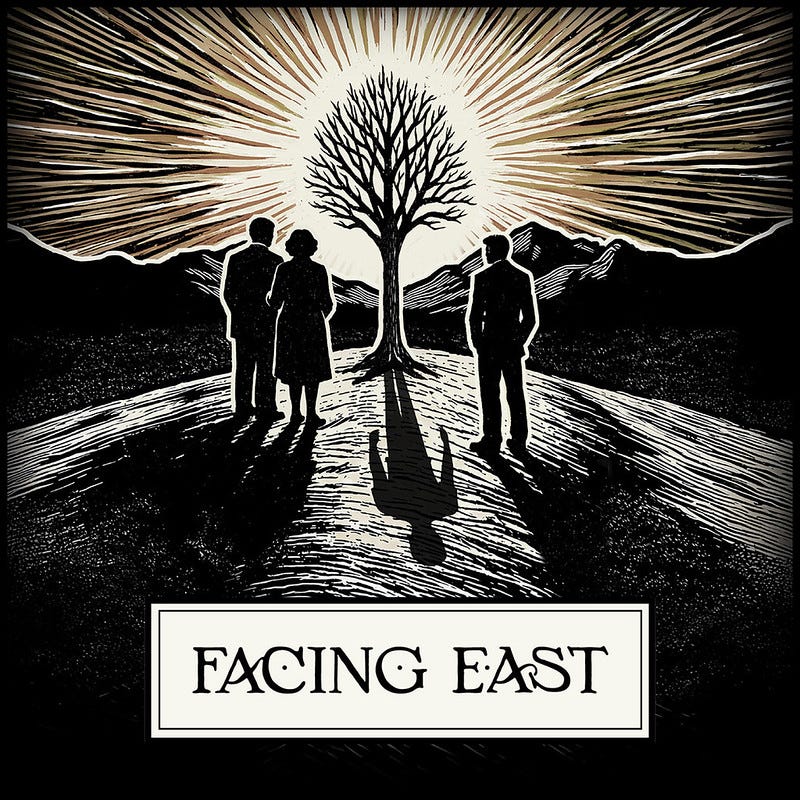
It’s in talking to “the truth trees” (as director Jerry Rapier calls them) that Ruth and Alex attempt to messily, imperfectly sort through what the hell happened. To look back at the traces and residue left by their son’s life and death.
Andy never makes an appearance. The audience is given flashbacks from his life from the points of view of Ruth, Alex, and Marcus, but at no point is Andy allowed to speak for himself. Even the words that should by rights be his are spoken by the other person on stage, filtered through personal biases, misinterpretations, and the inexactness of memory. All that’s left of him—who he really was, not just the facts listed in his obituary—is intangible ephemera.2
There was no one watching me when I furtively read Pearson’s words in the stacks. There is seldom an audience surveying any of us when we’re at our lowest point. Facing East gives its attendees and readers the rare experience of being able to witness that level of vulnerability in the safe confines of a play. As with the set, it’s confronting. What will you do when Ruth admits her addiction to pills or Alex confesses to being unfaithful in his marriage? What will you think when they blame their own behaviors for Andy being gay?
Will you come away and condemn them for being close-minded? Or will you sit and listen, quietly accepting the gift they’ve given you? Will you handle it with the reverence and care you wish someone would provide your own flaws?
When he arrives at the graveside, Andy’s boyfriend Marcus doesn’t have any more answers than Alex and Ruth. Even though he saw parts of Andy that others refused to see and is uniquely situated outside the family and the church, Marcus also can’t figure out how this happened. Even though it seems like the easy, obvious answer, he can’t bring himself to fully blame Andy’s death on his parents or the church.
“You and your church created the man I loved. And destroyed him. For that I will always hate you.” Marcus says, played by Kaplan Keener with a balance of earnest, raw grief and sharp humor that catches you off guard.
Ruth and Alex flinch, expecting and perhaps needing the blame to be laid at their feet. But then Marcus continues, “And always love you. Love you for all the good things you taught your son.”
There is no neat answer to the question of “what the hell happened?” and Pearson doesn’t attempt to give one. Skilled at conveying nuance, Pearson lets two apparently contradictory things be true at once in a way that I rarely find in media exploring queerness and Mormonism.
Pearson wrote with seemingly infinite faith in the church, a faith that I’ve found both impressive and frustratingly naive over the years. More than the organization of the church, Pearson’s seemingly infinite faith seems to be in the people who make it up. People will always surprise you, like Terysa giving me a book on being gay that didn’t challenge my beliefs, or Marcus telling Alex and Ruth that he loves them for creating the man he loved.
It’s only when I’ve given people the chance to be their complex, contradictory selves with me that I’ve had an even greater capacity to love them—and that I’ve been able to be loved myself.
At the end of Facing East, Alex entreats of Ruth: “What if we were wrong?”
If things are not as black and white as we were raised to think, how does that change how we interact with the world and each other? How will we remember each other? How will we treat each other while there is still time to take cautious steps forward to connection and understanding, no matter how uncomfortable or messy?
And if we will be misunderstood after our deaths no matter what, will we show up like Marcus did for Andy and Terysa did for me and choose to be an unexpected answer to prayer for one another anyway?
Becca Appel-Barrus lives in Salt Lake with her wife and two cats, writing extremely niche fiction and enjoying extremely underrated media. She strongly encourages you to go watch Bodkin (2024), Barb and Star Go to Vista Del Mar (2021), and That Thing You Do! (1996).
1 Nephi 8:11–12
José Esteban Muñoz. “Ephemera as Evidence: Introductory Notes to Queer Acts.” Women & Performance: a journal of feminist theory. 1996
In his essay “Ephemera as Evidence: Introductory Notes to Queer Acts,” José Esteban Muñoz explores the idea that because queerness has historically had to be covertly expressed to avoid ostracism and violence, evidence of queerness is left as anecdotal and performative rather than anything tangible or solid. And because there is no solid evidence, it becomes even easier to erase unpalatable truths.

Becca thank you so much for spending time with us and for being so open and vulnerable with your own story. - Jerry @ Plan-B Theatre